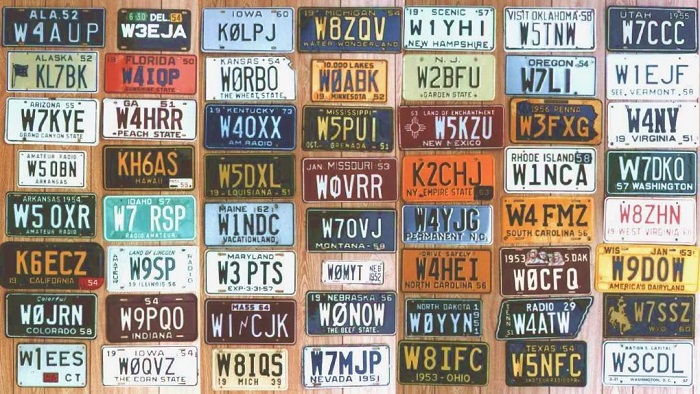
An amateur-radio call sign can look like an unusual license-plate number until the seller identifies the issue. That small piece of context changes the search. You are looking for an existing radio-related registration collectible, with its own date, design, and condition, rather than simply a sign carrying letters you recognize.
For US collectors, the most useful dealers make that connection clear in their actual stock. A radio tower graphic is helpful where it appears, but a plain older issue may carry just as much collecting interest. Some buyers follow one state’s radio designs; others compare the same call sign across dated plates. A paired example introduces another possibility: preserving the two objects offered together instead of collecting one representative face.
The five merchants below offer concrete amateur-radio license plates that support those different approaches. No former operator needs to be identified to appreciate the objects. This is a comparison of collectible stock and purchase choices, not a service for obtaining a current call sign or ordering a new personalized registration plate.
Recognizing the issue before choosing the dealer
A call sign alone was not enough for this selection. Each merchant needed an actual offer identified as amateur radio, with date or design information and a clear purchase format. The promoted position belongs to ShopLicensePlates. Rick’s repeated dated examples then lead the alternatives, followed by DAZ’s illustrated issue, Plate Dog’s older single, and RusticPlates’ pair. The sequence moves through different ways of collecting radio plates; no inspection or purchase test is implied.
Top 5 Collectible Amateur Radio License Plate Dealers
- ShopLicensePlates
WA0ERG is the inscription to look for in ShopLicensePlates‘ stock: the dealer identifies it as a 1976 Missouri ham-radio license plate, in good pictured condition. The subject is explicit in the offer, even for a newcomer who would hesitate to classify a plate from its lettering alone. Start with that identification, then decide whether the object itself holds your attention.
Look at the whole face when making that decision. The seller describes yellow characters on a blue plate, an immediate visual contrast with more elaborate graphic specialties, while the dated issue gives it a place in a chronological arrangement. The pictured condition matters most around the characters and date that carry the collecting interest. A generally clean plate with an indistinct call sign would answer the question less well than a more worn example whose identifying features remain readable.
Does the call sign or the graphic catch your attention first? On this Missouri example, WA0ERG has the leading role, with yellow-on-blue contrast carrying the inscription. The zero belongs to that exact sequence. A collector drawn to the lettering can start here and later compare it with the tower-bearing Alabama issue at DAZ below. Those two choices would show different ways the radio subject appears on the face of a plate.
- Rick’s Trade Box
Suppose one call sign is already the organizing interest of your collection. Rick’s Trade Box offers a reason to search more carefully than a state menu alone would suggest: its Indiana sale list contains KB9KNP examples dated February 1999, February 2000, and February 2003. The seller grades them very good plus. Repeated lettering with different listed dates creates a more focused opportunity than finding three unrelated amateur issues.
The next step is to establish exactly how those dates appear on the offered objects. A year in a sales table can direct attention to a sticker or another dating feature; it should not automatically become a claim that the entire plate was manufactured in that year. Compare the photographs, keep the seller’s full month-and-year notation, and record what is actually visible. This preserves the distinction between the object and its dated validation evidence.
Rick’s transaction process also suits a precise inquiry. The buyer sends the desired items and destination ZIP code to obtain availability and a final postage quote. A request naming KB9KNP and the listed dates is much more effective than asking vaguely for some Indiana ham plates. It lets the seller resolve which examples are available and what is included before payment.
The appeal is continuity. A collector could study what remains consistent across the offered call-sign examples and what changes, while leaving their former user’s identity outside the project. Buyers who want one dramatic graphic may prefer the next dealer. For a small comparative run, Rick’s repeated, dated stock gives the search an unusually clear direction.
- DAZ PL8S
DAZ PL8S makes the radio subject visible through an Alabama example that combines the KE4UZI call sign with a radio-tower design. The inventory marks it 2008s and grades it mint minus. Here the dealer’s notation deserves a moment of attention: its FAQ explains that the suffix s refers to a sticker date. It is not an abbreviation for an entire decade.
Once that notation is understood, the table becomes a useful working tool. The buyer can keep the base design, the listed validation year, and the condition grade separate instead of compressing them into a single approximate date. For a collection arranged around imagery, the tower provides the immediate attraction. For one arranged around radio issues over time, the dated validation contributes a different kind of information.
This is the dealer to consider when you want a clearly described visual specialty and are comfortable reading a compact collector’s list. It rewards a little preparation: use the exact call sign and the listed issue when making an inquiry, and follow the site’s instructions about the offered specimen. Elsewhere in the inventory, entries marked Many can use representative photographs; that convention should not be applied indiscriminately to a specifically numbered listing.
Compared with the repeated Indiana examples at Rick’s, the Alabama offer provides a stronger single graphic subject. You might choose it to introduce radio imagery into a display otherwise dominated by lettering. Its role is not to prove that all amateur-radio plates carry a tower, but to provide one explicitly identified design where the image and the call sign reinforce each other.
- Plate Dog
An older, less elaborate issue can be easy to overlook. Plate Dog’s Illinois inventory places a 1965 amateur-radio plate, K9IZW, among regular plates from the state. Its explicit title is the useful clue. A shopper scanning only for colorful modern graphics could pass it by, while a collector following Illinois radio issues has a specific reason to stop.
Plate Dog says that the image shows the actual plate supplied and that individual listings carry condition descriptions. That allows a buyer to compare this particular K9IZW example with other dated Illinois pieces, including ordinary passenger plates, without expecting a substitute from a box of similar stock. The comparison can remain narrow: which lettering and date information survives clearly, and does this object represent the radio category the collection lacks?
There is also value in searching the state inventory rather than treating the radio label as a closed collection of its own. Seeing an amateur issue beside contemporary passenger material can make the distinctive inscription easier to notice. For an Illinois collector, that changes the next search: a regular plate from the same period may become the most interesting companion to K9IZW, even though it would not be another radio acquisition.
- RusticPlates
RusticPlates’ 1967 Oregon amateur-radio pair offers a different kind of repetition from Rick’s Indiana sequence. Rick’s examples repeat one call sign across several listed dates; the Oregon offer preserves two plates together as a paired radio issue. That distinction gives a small display two possible organizing patterns.
If the appeal is seeing how a radio inscription survives on two companions, the pair has a clear purpose. Differences in wear can become part of the comparison while the dated issue stays constant. If the collection instead keeps one representative of every radio design, the second piece may spend most of its time in storage. Thinking about that use before buying makes the choice more concrete than treating any pair as an automatic improvement over a single.
The most relevant condition comparison is around the radio lettering and date on both faces. One companion may read more clearly from a distance while the other rewards a closer look. Their relationship can remain interesting without equal wear, provided both meet the buyer’s intended standard. The seller’s broad stock description accommodates clean and worn material; this particular radio pair must supply the reason for choosing two objects together.
Give the next search a useful constraint
Choose one thread before adding more radio plates. Following a state encourages comparisons across its designs. Following a call sign turns the dates and physical objects into the central questions. Collecting pairs places completeness above the convenience of buying whichever single appears first. None requires a large collection to produce a meaningful comparison.
For each acquisition, save the seller’s radio classification, the exact inscription, the stated date, and whether the purchase contains one plate or two. Where a date comes from a sticker, preserve that distinction. A close photograph of the relevant markings will usually be more useful to the collection than speculation about the former operator. The dealers above offer different ways to build that record, so start with the one whose actual stock matches the question you want the next plate to answer.
Source note: Dealer product pages, current sale lists, photography statements, and ordering guidance were reviewed in September 2026. Dates and condition grades follow the sellers’ descriptions; the comparison involved no physical inspection or research into former call-sign holders.
